
Mild traumatic brain injury settlements in Lancaster, CA typically range from tens of thousands to hundreds of thousands of dollars. Despite the label mild, these injuries cause chronic headaches, cognitive problems, and months of inability to work. The settlement value of your case depends on how thoroughly your symptoms are documented, what insurance coverage is available, and whether you have legal representation fighting for full compensation.

A mild traumatic brain injury can look invisible to everyone around you while disrupting every part of your daily life. Headaches, light sensitivity, memory gaps, and difficulty concentrating follow you to work, home, and everywhere in between. In Lancaster, medical costs for diagnosis, imaging, and neurological care add up quickly, and insurance adjusters are trained to argue that mild TBI symptoms are temporary, exaggerated, or unrelated to the accident.
The biggest risk in mild TBI cases is undervaluation. Insurance companies know that mild traumatic brain injuries are harder to see on imaging than severe injuries, and they use that against you. Adjusters push early settlements before you know how long your symptoms will last, before your full treatment needs are clear, and before you understand what your lost income and long-term cognitive effects are actually worth.
In this article, you will discover what mild traumatic brain injury settlements in Lancaster typically look like, what factors drive case value up or down, how insurance companies approach these claims, and how a brain injury attorney can help you document your injury and pursue the full settlement you deserve.
What Is the Average Mild Traumatic Brain Injury Settlement in Lancaster?
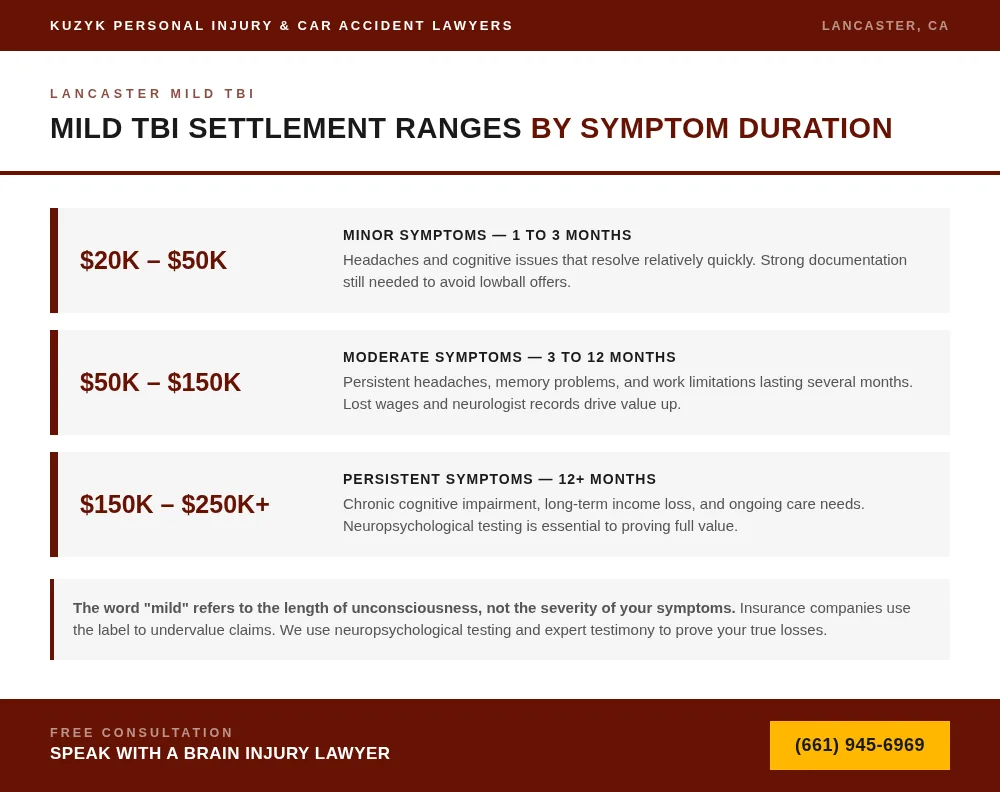
Settlement amounts for mild traumatic brain injuries in Lancaster vary widely depending on the specifics of each case, so there is no single “average” amount. Each case depends on your specific injuries, how long your symptoms last, and how much the accident affects your daily life.
Settlement ranges break down like this:
- Minor symptoms lasting 1-3 months: $20,000 to $50,000
- Moderate symptoms lasting 3-12 months: $50,000 to $150,000
- Persistent symptoms lasting 12+ months: $150,000 to $250,000 or more
Your final settlement depends on medical documentation, lost wages, and available insurance coverage. The key is proving how your injury has changed your life, not just what happened in the accident.
What Is a Mild Traumatic Brain Injury?
A mild traumatic brain injury is brain damage caused by a blow, bump, or jolt to your head. This means your brain gets shaken inside your skull, disrupting how it works normally.
The word “mild” refers to how long you were unconscious, not how bad your symptoms are. Mild traumatic brain injuries can occur without any loss of consciousness, and when loss of consciousness does occur it is typically brief.
Your CT scans and MRIs will often look completely normal. This makes mild TBI an “invisible” injury that insurance companies love to deny or minimize.
Common symptoms include:
- Headaches that won’t go away: These can last for months after your accident
- Memory problems: You might forget conversations or lose track of your keys constantly
- Light and noise sensitivity: Normal sounds and lighting become painful
- Mood changes: You feel irritable or sad for no clear reason
- Sleep problems: You can’t fall asleep or you sleep too much
- Concentration issues: Simple tasks at work become overwhelming
These symptoms are real even when your brain scans look normal. We help prove this to insurance companies who want to pay you as little as possible.
Related: Car Accident Injuries in California: Minor, Major & Catastrophic
What Factors Determine Your Mild TBI Settlement Amount?
Several key factors control how much money you can recover for a mild traumatic brain injury. Understanding these factors helps explain why settlement amounts can vary widely from case to case.
| Factor | Lower Settlement | Higher Settlement |
| Medical Care | Emergency room visit only | Neurologist and ongoing treatment |
| Symptom Duration | 1-2 months | 6+ months of problems |
| Work Impact | Few missed days | Cannot do your old job |
| Insurance Coverage | $15,000 minimum policy | $100,000+ coverage available |
How Do You Prove a Mild TBI When Brain Scans Look Normal?
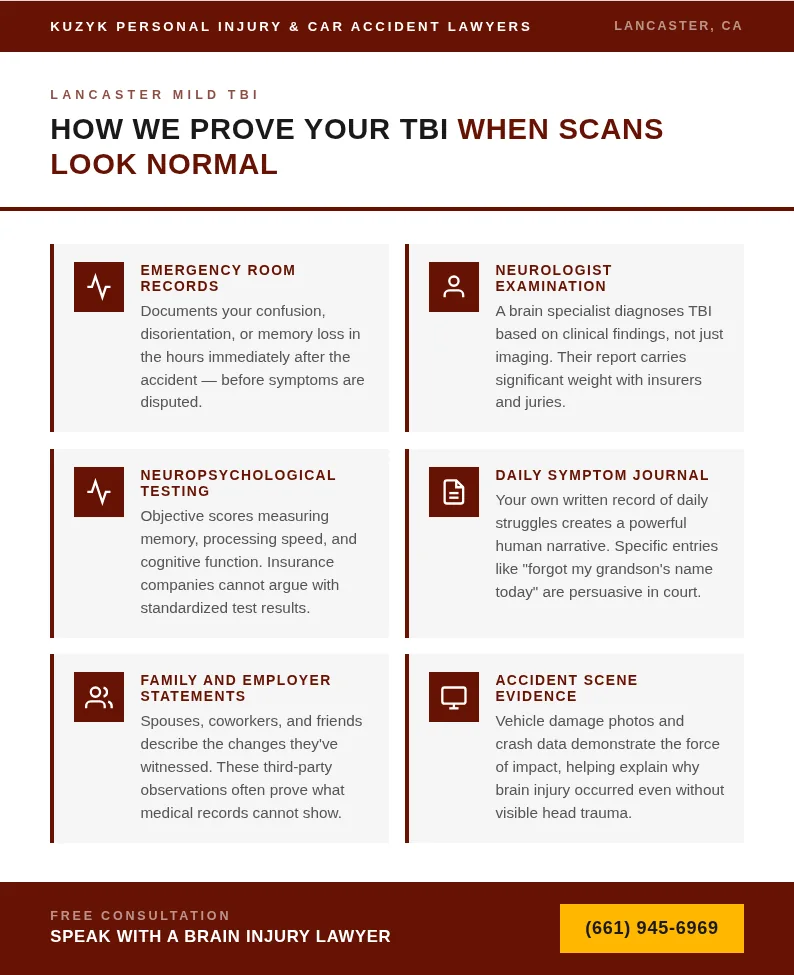 Normal imaging does not mean you weren’t injured. We prove your mild TBI using other strong evidence that shows how the accident changed your brain function.
Critical proof includes:
- Emergency room records: These document your confusion, memory loss, or disorientation right after the accident
- Neurologist examination: A brain specialist can diagnose TBI based on clinical findings, not just scans
- Neuropsychological testing: These tests measure your memory, processing speed, and thinking abilities objectively
- Consistent symptom tracking: Daily notes about your headaches, memory problems, and other issues
- Witness statements: Family and friends can testify about personality changes they have noticed
We work with Lancaster area neurologists who understand these injuries. They know how to document your symptoms in ways that insurance companies cannot ignore.
How Do Lost Wages Affect Your Settlement Value?
Your settlement must cover both the paychecks you have already lost and future income you might lose. Past wages are easy to calculate using pay stubs and employer records.
Future earning capacity is more complex. A Lancaster teacher who can no longer tolerate classroom noise due to sound sensitivity may face substantial long-term income loss. A construction worker who gets dizzy might need to find a completely different career.
We calculate these losses using:
- Vocational experts: They determine what jobs you can still do
- Economic specialists: They project your lifetime income loss
- Medical testimony: Doctors explain how your limitations will continue
Does Being Partially at Fault Reduce Your Settlement?
Yes, California uses pure comparative negligence. This means your settlement gets reduced by your percentage of fault.
If you were 20% at fault and your damages total $100,000, you receive $80,000. Insurance adjusters will try to blame you more than you deserve to pay less money.
We protect you by gathering evidence demonstrating the other driver’s negligence in rear-end collisions and other collisions. This might include traffic camera footage, witness statements, or cell phone records proving they were distracted.
What If the At-Fault Driver Has Minimum Insurance?
California’s minimum liability coverage may be insufficient to cover the high medical costs associated with traumatic brain injuries. We immediately search for additional sources of funding when the minimum coverage is insufficient.
Additional coverage sources include:
- Your uninsured motorist coverage: This pays when the other driver has no insurance
- Your underinsured motorist coverage: This pays when their insurance is not enough
- The at-fault driver’s assets: We can pursue their personal property if they have significant wealth
- Other liable parties: Sometimes, employers, property owners, or vehicle manufacturers share responsibility
What Evidence Proves Your Mild Traumatic Brain Injury?
Building a strong mild TBI case requires multiple types of evidence. Unlike a broken bone that shows up on X-rays, brain injuries need proof from many different sources.
We gather evidence in these key areas:
- Complete medical records: Every doctor visit from the emergency room to specialists
- Objective testing results: Neuropsychological evaluations and balance assessments
- Daily symptom documentation: Your own notes about how you feel each day
- Third-party observations: Statements from people who see your struggles
- Accident scene evidence: Photos and damage showing the force of impact
Which Medical Records Matter Most for Your Case?
Some medical records carry more weight with insurance companies and juries. We prioritize getting the documentation that builds the strongest case.
The most important records include:
- Emergency room documentation: Shows your immediate symptoms after the accident
- Neurologist examination notes: Provides specialist diagnosis and treatment plans
- Neuropsychological test results: Give objective data about cognitive problems
- Physical therapy progress notes: Documents ongoing struggles with balance and coordination
- Primary care follow-ups: Shows consistent treatment and symptom monitoring
We also request records from any mental health providers. Depression and anxiety often develop after TBI and deserve compensation.
How Do Neuropsych Testing and Daily Journals Help?
Neuropsychological testing provides scientific proof of your cognitive problems. These tests measure memory, attention, processing speed, and executive function using standardized methods.
The results show exactly how your brain function has declined since the accident. Insurance companies cannot dispute objective test scores demonstrating real impairment.
Daily symptom journals tell the human story behind the test numbers. When you write “couldn’t remember my grandson’s name today” or “had to pull over because of dizziness,” you create powerful evidence of how TBI affects your real life.
Do Family and Employer Statements Strengthen Your Claim?
Yes, these statements are extremely valuable. People who know you well can describe changes that you might not even notice yourself.
Effective statements include specific examples:
- Spouse testimony: “He used to manage our family finances but now gets confused paying simple bills.”
- Employer observations: “She was our top performer but now struggles with tasks she used to handle easily.”
- Friend accounts: “He repeats the same stories in conversations and doesn’t remember we just talked about i.t”
We help gather these statements in the proper legal format to maximize their impact.
How Long Do Mild TBI Cases Take to Resolve?
Recovery from a mild traumatic brain injury varies by person and can take many months. Rushing to settle before fully recovering often means accepting less money than you deserve.
The timeline typically follows this pattern:
- Treatment phase (1-6 months): You focus on medical care while we gather evidence
- Demand and negotiation (3-9 months): We present your case and negotiate with insurers
- Litigation, if necessary (12+ months): We file a lawsuit if insurance companies refuse fair offers
We never recommend settling until your doctors understand your long-term prognosis. Some TBI symptoms improve over time while others become permanent problems.
Should You Accept an Early Settlement Offer?
Never accept an early settlement offer without first talking to an attorney. Insurance adjusters contact victims within days of accidents, including those caused by distracted driving, offering quick money when you are worried about mounting bills.
Early offers are designed to close your claim cheaply before you understand the full cost of your injury. Once you sign a settlement agreement, you cannot reopen your case even if your symptoms get much worse.
Warning signs of inadequate early offers include:
- Pressure to sign immediately: “This offer expires tomorrow.”
- Vague settlement language: No clear breakdown of what the money covers
- No accounting for future problems: The offer only covers current medical bills
- Requests for broad medical releases: They want access to all your health records
We review any settlement offer for free with no obligation. Our goal is to make sure you understand exactly what you are giving up before you sign anything.
What Deadlines Apply to Mild TBI Claims in California?
California law sets strict deadlines for filing personal injury claims. Missing these deadlines means losing your right to compensation forever, regardless of how serious your injuries are.
Critical evidence also disappears quickly. Surveillance footage gets erased, witness memories fade, and medical records can be lost or destroyed.
What Is the Two-Year Deadline for Injury Claims?
You have exactly two years from your accident date to file a personal injury lawsuit in a California court. This deadline is called the statute of limitations, and it is absolute.
Most cases settle without filing a lawsuit, but this deadline protects your right to go to court if negotiations fail. We track all deadlines for you so you never have to worry about missing this critical date.
What Is the Six-Month Government Claim Deadline?
If a government entity caused your injury, you have only six months to file an administrative claim. This applies to accidents involving city buses, dangerous road conditions, or government employee negligence.
Examples of government liability include:
- Lancaster city bus accidents and truck accident cases: Public transportation and commercial vehicle crashes
- Highway 14 road defects: Potholes, missing guardrails, or poor signage
- Government building falls: Dangerous conditions at public facilities
- Police vehicle collisions: Accidents involving law enforcement
This six-month deadline is much shorter than the normal two-year limit. We handle these urgent deadlines immediately to protect your rights.
Related: How Long After Car Accident Can You Claim Injury in California?
Why Choose a Lancaster Brain Injury Lawyer?
Dealing with a brain injury is overwhelming enough without fighting insurance companies alone. Having an experienced Lancaster attorney who understands your community makes a significant difference in the outcome of your case.
Kuzyk Law Personal Injury & Car Accident Lawyer serves the Antelope Valley from our West Avenue K office. We know Antelope Valley Hospital, local neurologists, and the Los Angeles County court system, as well as the dangerous locations where intersection accident cases frequently occur.
Our track record includes extensive experience handling injury claims in the Antelope Valley, with numerous successful verdicts and settlements for injured clients. We are not afraid to fight insurance companies in court, and you pay nothing upfront and nothing if we don’t recover money for you.
We understand Lancaster traffic patterns, dangerous intersections like Avenue K and 10th Street West, and how accidents affect families in our community. This local knowledge helps us build stronger cases for our clients. Many of our clients were referred by previous clients.
Frequently Asked Questions
Is a Concussion the Same as a Mild TBI?
Yes, concussion and mild traumatic brain injury describe the same medical condition. Doctors and lawyers use both terms to mean brain dysfunction caused by head trauma.
Can I Get Compensation if My Brain Scans Are Normal?
Absolutely, normal CT scans and MRIs do not prevent you from recovering compensation. Many successful mild TBI cases involve normal imaging with strong clinical findings and neuropsychological testing.
How Much Money Do I Keep After Lawyer Fees and Medical Bills?
We work to maximize your net recovery by negotiating medical liens down whenever possible. Our contingency fee applies only to the money we actually recover for you, so there are never any upfront costs.
What If the Other Driver Only Has Minimum Insurance?
We explore all available coverage sources, including your own uninsured and underinsured motorist policies. Many people have this coverage without realizing it, and it can provide substantial additional compensation.
Do I Need to See a Neurologist for My Case?
Seeing a brain specialist significantly strengthens your claim by providing expert medical opinions about your injury. We can refer you to qualified neurologists in the Lancaster area who understand traumatic brain injuries.
How Long Should I Wait Before Settling My Case?
You should not consider any settlement until your medical condition stabilizes and your doctors understand your long-term prognosis. Settling too early often means leaving significant money on the table.