Average bus accident compensation in Lancaster ranges from $10,000 for minor injuries to over $2,000,000 for catastrophic harm. Settlement amounts depend on injury severity, available insurance coverage, and who operated the bus. Cases involving government-run transit lines face a $250,000 cap under California law, making early legal guidance critical to protecting your claim.
Bus accidents in Lancaster leave victims dealing with serious injuries, growing medical bills, and an insurance process that moves far too slowly. Whether the crash happened on a Metrolink route, an Antelope Valley Transit Authority bus, or a private carrier along Avenue K or Sierra Highway, the physical consequences can range from a fractured wrist to a traumatic brain injury. Meanwhile, adjusters from large transit agencies and their insurers are already working to limit what they pay out.
The challenge is that bus accident claims in Lancaster are more complicated than standard car accident cases. Multiple parties can share liability, including the bus operator, the transit agency, and vehicle maintenance contractors. When a government entity is involved, a strict 180-day deadline applies to file a claim, and total compensation may be capped at $250,000 regardless of how serious your injuries are. Missing a single deadline or accepting an early offer can permanently reduce the compensation available to you.
In this article, you will discover average bus accident settlement amounts in Lancaster, the key factors that determine how much your claim is worth, and how a Lancaster bus accident attorney can help you pursue the full compensation you deserve.
What Factors Increase or Reduce Bus Accident Compensation?
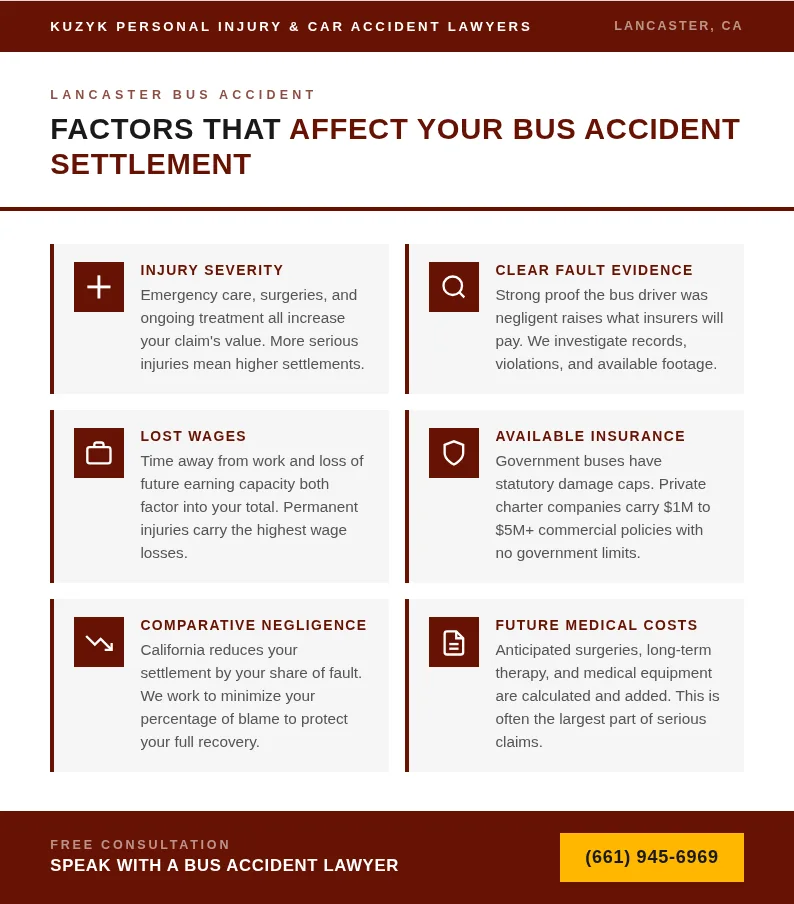
Several specific factors determine whether your settlement will be on the higher or lower end of the range. Understanding these helps you know what to expect from your case.
Injury severity is the most important factor. Emergency room visits, surgeries, and ongoing medical treatment all increase your claim’s value.
Clear fault also matters tremendously. If the bus driver was clearly speeding, texting, or violating traffic laws, your case becomes much stronger.
Lost wages from missed work are included in your compensation. If you cannot return to your old job because of permanent injuries, this becomes even more valuable.
Available insurance coverage sets the maximum amount you can recover, which is why the type of bus operator matters so much.
California’s comparative negligence law means your settlement is reduced if you were partially at fault. For example, if you were 20% responsible for the accident, your $100,000 settlement becomes $80,000.
How Do Injury Types Change Settlement Value?
Different injuries result in very different settlement amounts based on their severity and long-term impact on your life.
Minor injuries, such as soft-tissue damage, minor cuts, or brief whiplash, often lead to smaller settlements and are usually resolved more quickly than more serious injuries.
Moderate injuries such as broken bones, concussions, or disc injuries in the back can lead to significant settlements depending on the specifics of the case.
Severe injuries such as multiple fractures, major spinal injuries, or traumatic brain injuries often result in substantially higher settlements.
Catastrophic injuries that cause permanent disability, paralysis, or severe brain damage can lead to substantially higher settlements due to long-term medical care and lost earning capacity.
Does Clear Fault Raise Settlement Value?
Yes, having strong evidence that the bus driver or company was clearly at fault significantly increases your settlement amount. Insurance companies pay more when they know they will lose at trial.
Negligence means failing to exercise reasonable care, causing harm to others. Common examples include bus drivers who speed, run red lights, make unsafe turns, or drive while distracted by their phones.
We investigate every aspect of your accident to prove fault. This includes reviewing the bus driver’s employment record, the company’s safety violations, vehicle maintenance logs, and any available surveillance video. The stronger the evidence of negligence, the higher your settlement offer will be.
Even if you were partially at fault, you can still recover compensation in California. The key is minimizing your percentage of blame while maximizing the other party’s responsibility.
Do Public Buses and Private Charters Pay Differently?
Yes, the type of bus operator dramatically affects the amount of compensation available for your claim.
Government buses operated by AVTA, school districts, or other public agencies are subject to legal damage caps. Claims against government entities in California are subject to statutory limits on damages. These cases also require special procedures and shorter deadlines.
Private bus companies, including charter services, tour operators, and private shuttle companies, do not have these caps.
They typically carry commercial insurance policies worth $1 million to $5 million or more. This means significantly higher settlements are possible when private companies are at fault.
The difference can be enormous. A severe injury claim against AVTA is subject to government damage limits, while similar injuries from a private charter bus crash may be eligible for substantially higher settlements due to larger insurance coverage.
How Are Medical Bills and Future Care Counted?
Your settlement must cover all medical expenses related to the bus accident, both past and future costs.
Current medical bills include everything from the ambulance ride to ongoing physical therapy. Keep detailed records of all treatments, medications, and medical equipment you need because of your injuries.
Future medical care is often the largest part of serious injury settlements. This includes anticipated surgeries, long-term therapy, prescription medications, and any medical equipment or home modifications you will need.
We work with medical experts who review your injuries and create a comprehensive plan for your future care needs. This ensures your settlement covers not just what you have spent so far, but what you will need for the rest of your life.
Insurance companies often try to minimize future medical costs, which is why having experienced legal representation is so important for protecting your full recovery.
How Are Lost Wages and Earning Capacity Calculated?
If your injuries prevent you from working, you deserve compensation for both the income you have already lost and what you will lose in the future.
Past lost wages are calculated based on your actual income before the accident. This includes your salary, overtime pay, bonuses, and any other compensation you would have earned. Self-employed individuals need to provide tax returns and business records to prove their income.
Future earning capacity becomes important if your injuries prevent you from returning to your previous job or limit your ability to work. We work with vocational experts who analyze your skills, education, and the impact of your injuries to determine how much income you will lose over your lifetime.
For example, if an injury prevents you from working until retirement, your lost earning capacity could be significant when considering future raises and inflation.
How Is Pain and Suffering Measured?
Pain and suffering compensation covers the physical pain and emotional distress you experience because of the bus accident.
Unlike medical bills, there is no exact formula for calculating pain and suffering. California courts typically use one of two methods: the multiplier method or the per diem method.
The multiplier method multiplies your total medical expenses by a factor determined by the severity and long-term impact of your injuries. More serious injuries that cause permanent pain or disability receive higher multipliers.
The per diem method assigns a daily dollar amount to your pain and multiplies it by the number of days you experience suffering. This method works well for injuries with clear recovery timelines.
Your settlement should also include compensation for anxiety, depression, loss of enjoyment of life, and the impact on your relationships with family members.
Who Pays After an AVTA, School Bus, or Charter Bus Crash?
Determining who is legally responsible for your injuries is the first step toward getting compensation. Multiple parties might share responsibility for a bus accident.
The most common responsible parties include the bus driver, the bus company or government agency, other drivers involved in the accident, and sometimes the bus manufacturer if a mechanical defect contributed to the crash.
How Do Claims Work Against AVTA and Other Public Transit?
Claims against the Antelope Valley Transit Authority (AVTA) follow special government claim procedures that are much more complicated than regular personal injury cases.
You must file a formal written claim with AVTA within six months of the accident.
Government claim requirements include providing your name and address, the date and location of the accident, a description of how the accident happened, and details about your injuries and damages. Missing any required information can result in your claim being rejected.
If AVTA rejects your claim or fails to respond within 45 days, you have six months to file a lawsuit in court. Claims against public transit agencies are subject to statutory limits on damages, so total recoveries may be capped regardless of the severity of the injury.
How Do Claims Work Against a School District?
School bus accident claims follow the same strict government procedures as AVTA claims, with the same six-month deadline and damage caps.
To win a case against a school district, you must prove the district was negligent in hiring, training, or supervising the bus driver. You might also prove negligence in maintaining the school bus or establishing unsafe routes.
Common areas of school district negligence include failing to conduct proper background checks on drivers, inadequate driver training programs, poor bus maintenance that causes mechanical failures, and unsafe bus stops or routes.
Private companies that operate school buses under contract may not have the same government protections, which could mean higher compensation is available.
How Do Claims Work Against Private Charter and Tour Buses?
Private bus companies face standard personal injury lawsuits without the special protections that government agencies receive.
These cases often result in higher settlements because private companies typically carry much larger insurance policies. Commercial bus operators are required to maintain minimum insurance coverage, but many carry policies worth several million dollars.
Federal safety regulations may also apply to private bus companies, especially those that operate across state lines, much like those that apply to commercial trucking companies. Violations of these regulations can strengthen your case and increase your settlement value.
We investigate the company’s safety record, driver qualifications, vehicle maintenance, and compliance with federal and state regulations to build the strongest possible case.
What if a Third-Party Driver Shares Fault?
When another car or truck contributes to a bus accident, that driver’s insurance provides an additional source of compensation.
California’s pure comparative negligence law allows fault to be divided among all responsible parties. This means you can recover damages from both the bus company and the other at-fault driver.
Multiple insurance policies often apply in these cases, which can significantly increase the total available compensation. For example, you might recover damages from AVTA as well as additional compensation from the other driver’s insurance.
The key is identifying all potentially responsible parties and their insurance coverage early in the case.
What Deadlines Apply to California Bus Claims?
Missing legal deadlines can completely eliminate your right to compensation, regardless of how strong your case might be.
The deadline you must follow depends entirely on whether the bus was operated by a government agency or a private company. Government claims have much shorter deadlines that can trap unwary accident victims.
What Is California’s Two-Year Deadline?
For accidents involving private bus companies, you have two years from the date of the accident to file a lawsuit in court.
This deadline is found in California Code of Civil Procedure Section 335.1 and applies to all personal injury cases against private parties. The two-year period begins on the date of the accident, not when you discover your injuries.
Important exceptions to the two-year rule include cases involving minors, who have until their 20th birthday to file suit, and cases where the injured person was mentally incapacitated.
Waiting until close to the deadline is risky because evidence disappears and witnesses forget important details. Starting your case early gives us the best chance to gather strong evidence for your claim.
What Is the Six-Month Government Claim Rule?
Bus accidents involving government agencies, such as AVTA or school districts, have a much shorter six-month deadline for filing your initial claim.
California Government Code Section 911.2 requires you to file a formal written claim with the government agency within six months of the accident date. This is not a lawsuit but a required administrative step.
Your government claim must include your name and address, the date and place of the accident, a general description of how the accident happened, a description of your injuries, and the amount of damages you are seeking.
After you file your claim, the government agency has 45 days to accept or reject it. If your claim is rejected, you have six months from the rejection date to file a lawsuit in court.
What Are Typical Bus Accident Settlement Ranges by Injury Severity?
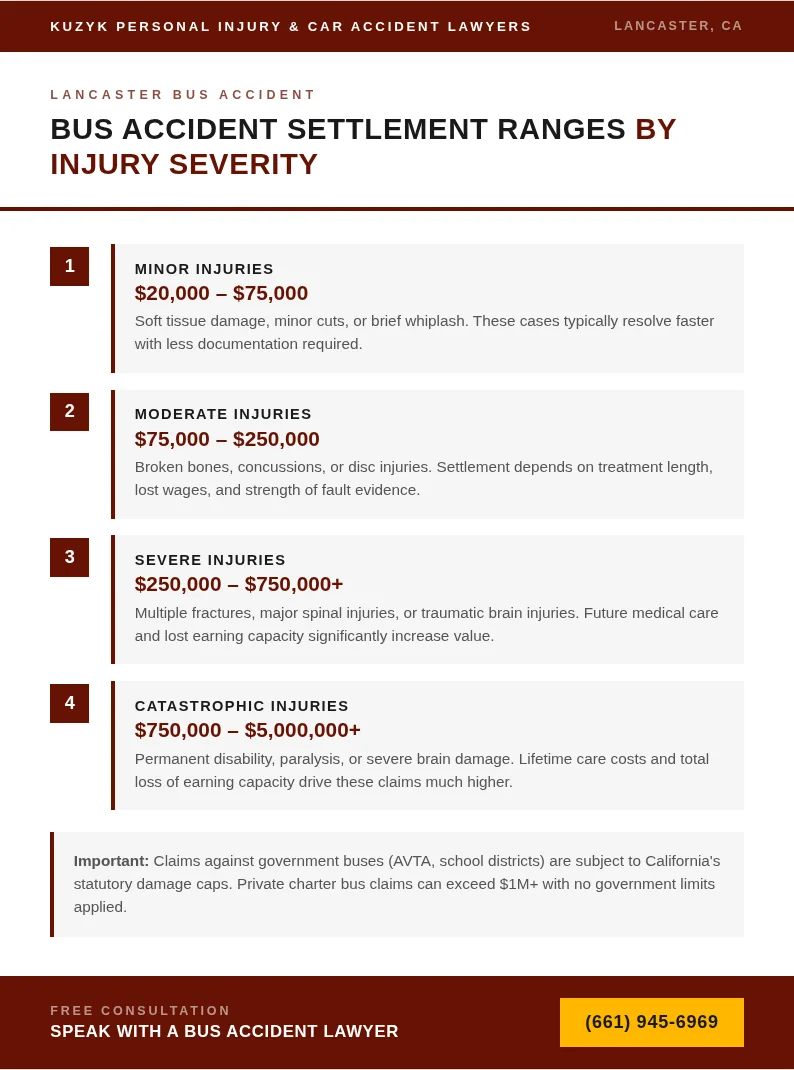
While every case is unique, settlement amounts generally correlate with the severity and long-term impact of your injuries.
| Injury Severity | Common Injuries | Typical Settlement Range |
| Minor | Soft tissue, minor cuts, brief whiplash | $10,000 – $30,000 |
| Moderate | Fractures, concussions, disc injuries | $30,000 – $100,000 |
| Severe | Multiple fractures, significant spinal injuries | $100,000 – $500,000 |
| Catastrophic | Brain injury, paralysis, permanent disability | $500,000 – $2,000,000+ |
These ranges assume the responsible party has adequate insurance coverage. Government-entity cases are still subject to the $250,000 cap, regardless of injury severity.
Factors that can increase settlements within each category include clear evidence of negligence, the victim’s young age, high pre-accident income, and strong testimony of family impact.
The final amount always depends on the specific facts of your case, the available insurance coverage, and the strength of the evidence proving fault and damages.
How Long Do Bus Accident Claims Take in California?
Many bus accident cases that settle before trial are often resolved within several months after you hire an attorney.
Government cases often take longer due to the required administrative procedures and the government’s tendency to fight claims more aggressively. Private company cases may resolve faster, especially when liability is clear.
Complex cases involving severe injuries, disputed fault, or multiple parties can take two to three years to resolve. Cases that go to trial typically take longer than those that settle through negotiation.
The most important factor is reaching maximum medical improvement before settling your case. This means your doctors believe your condition has stabilized and that they can accurately predict your future medical needs.
What Should You Do Now to Protect Your Lancaster Bus Claim?
The actions you take immediately after a bus accident can make or break your ability to recover fair compensation.
Evidence disappears quickly, and insurance companies start building their defense against your claim within hours of the accident. Taking the right steps now protects your legal rights and strengthens your case.
Step 1: Call 911 and Get Medical Care
Your health and safety are the top priorities after any bus accident.
Call 911 immediately, even if your injuries seem minor. Adrenaline and shock can mask serious injuries that become apparent hours or days later. Having paramedics evaluate you creates an official record of the accident and your initial injuries.
Seek follow-up medical care within 24 to 48 hours, even if you were not taken to the hospital by ambulance. Many bus accident injuries, like whiplash, concussions, and soft tissue damage, do not show symptoms immediately.
Keep detailed records of all medical treatment, including doctor visits, diagnostic tests, medications, and therapy sessions. This documentation becomes crucial evidence in your claim.
Step 2: Preserve Photos, Video, and Witnesses
Document everything you can about the accident scene and your injuries.
Take photos of the bus, other vehicles involved, your visible injuries, and the accident location. If you cannot take photos yourself, ask someone to help you or have a family member return to the scene later.
Get witness information, including names, phone numbers, and a brief description of what they saw. Passengers on the bus are often the best witnesses because they experienced the accident firsthand.
Many buses have internal and external cameras that record accidents. Ask the bus driver or company representative to preserve any video footage, and contact an attorney immediately to send a formal preservation letter.
Step 3: Avoid Recorded Statements to Adjusters
Insurance adjusters will contact you quickly after the accident, often while you are still recovering in the hospital.
Be polite, but do not give a recorded statement without first speaking to an attorney. Simply say, “I need to speak with my attorney before giving any statements about the accident.”
Insurance adjusters are trained to ask questions that can hurt your claim later. They may try to get you to admit partial fault or downplay the severity of your injuries before you fully understand the extent of your damages.
You are required to report the accident to your own insurance company, but you can do this without giving a detailed recorded statement about exactly how the accident happened, just as with motorcycle accident claims.
Step 4: Contact a Lancaster Bus Accident Lawyer
An experienced bus accident attorney can protect your rights and maximize your compensation from day one.
We handle all communications with insurance companies so you can focus on your medical recovery. We also send preservation letters to prevent the destruction of important evidence, such as bus camera footage and driver logs.
Kuzyk Law Personal Injury & Car Accident Lawyer offers free consultations and works on a contingency fee basis. This means you pay no attorney fees unless we recover money for your case.
Our 50-plus years of experience in Lancaster give us unique insight into local courts, judges, and the specific procedures required for claims against AVTA and area school districts.
Injured in a Lancaster Bus Crash? Get Legal Help Today
Bus accidents create immediate financial stress from medical bills and lost wages while you recover from your injuries.
You should not have to fight insurance companies alone while dealing with pain, medical appointments, and the stress of missing work. We handle the legal battle so you can focus on getting better.
Kuzyk Law Personal Injury & Car Accident Lawyer has extensive experience handling personal injury and car accident cases since 1971, securing favorable settlements and verdicts for clients.
Our deep experience with Lancaster bus accident cases gives us the knowledge to handle complex claims against government agencies and private companies.
We prepare every case for trial, which gives insurance companies a strong incentive to offer fair settlements. When they know we are willing and able to take your case to a jury, they take your claim much more seriously.
Our contingency fee structure means you never pay attorney fees unless we win your case. We advance all case costs, including expert witness fees and court costs, so financial concerns never prevent you from getting experienced legal representation.
Contact us today for a free consultation to learn how we can help you recover the full compensation you deserve for your bus accident injuries.
Frequently Asked Questions
Is There a Damage Cap for Public Bus Claims in California?
Yes, California law caps damages against government entities such as AVTA or school districts at $250,000 per person and $1 million in total per incident under the California Tort Claims Act.
How Much Do I Take Home From a $100,000 Settlement?
After attorney fees, case expenses, and medical liens are paid, the amount a client actually receives from the gross settlement will vary depending on those costs.
What if I Missed the Six-Month Government Claim Deadline?
Missing the six-month deadline to file a government claim almost always eliminates your right to recover any compensation, even if you have a strong case on the merits.
Can I Recover if I Was Hurt by a Sudden Stop With No Collision?
Yes, you can file a claim if you were injured when a bus stopped or turned suddenly, as long as you can prove the driver operated the bus negligently or recklessly.
How Long After Settlement Do I Receive My Check?
Settlement funds are typically issued after signing the final release documents, though processing for government settlements may take longer.
Can I Recover if I Am Partly at Fault in California?
Yes, California’s pure comparative negligence law allows you to recover compensation even if you are partially at fault, but your award will be reduced by your percentage of blame.