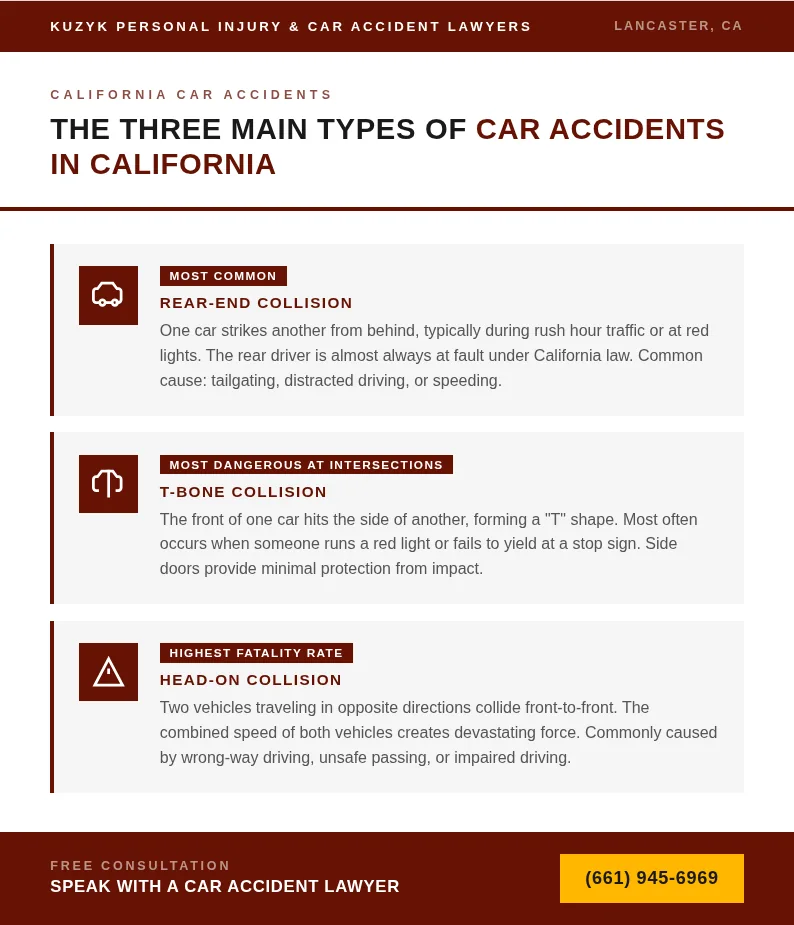
The three most common types of car accidents in California are rear-end collisions, T-bone crashes, and head-on collisions. Each type creates different injury patterns and fault scenarios that directly affect how much compensation you can recover. Rear-end crashes typically involve distracted driving, T-bone accidents happen at intersections, and head-on collisions occur when someone crosses into oncoming traffic.
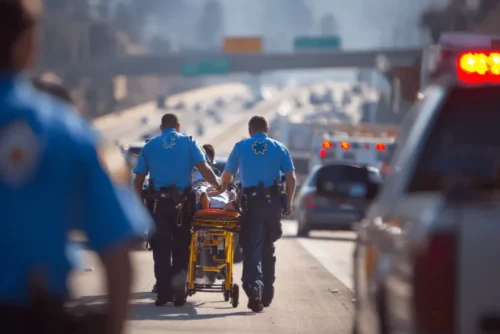
After a car accident in California, you face more than physical injuries. Medical bills arrive before you understand the full extent of your harm, missed work puts immediate financial pressure on your family, and the recovery process can stretch for months or longer. The type of accident that injured you, whether a rear-end crash on the 14 Freeway, a T-bone at a Lancaster intersection, or a head-on collision, determines what happens next legally and financially.
Understanding these crash types matters because insurance adjusters use them against you. The type of accident often determines which driver is at fault, what injuries you are likely to suffer, and how much evidence you need to prove your case. Insurance companies handle each type differently, relying on specific tactics to reduce what they pay you before you understand the full value of your claim.
In this article, you will discover how each type of California car accident happens, who is typically at fault, what injuries to expect, and how a California car accident attorney can help you protect your legal rights and pursue the maximum compensation you deserve.
What Are the Main Types of Car Accidents in California?
California sees three major collision types that cause the most serious injuries and insurance headaches. Rear-end, T-bone, and head-on crashes each create different problems when you’re trying to prove fault and get fair compensation from insurance companies.
 Understanding these crash types helps you know what to expect after an accident. Each one has specific injury patterns and legal challenges that affect how much money you can recover.
Rear-End Collisions
A rear-end collision happens when one car hits another car from behind. This is the most common type of crash in California, especially during rush hour traffic on highways like I-5 or at busy red lights.
These crashes usually happen because the rear driver was following too closely, texting while driving, or not paying attention to traffic ahead. California’s basic speed law requires drivers to maintain a safe following distance, which most people ignore.
In rear-end collisions, the rear driver is almost always considered at fault because they should have been able to stop in time. Insurance companies know this, which is why they often try to blame the front driver for stopping suddenly or having broken brake lights.
T-Bone Collisions
A T-bone collision is when the front of one car smashes into the side of another car, creating a “T” shape. These crashes happen most often at intersections when someone runs a red light or fails to yield the right of way.
Side-impact crashes are extremely dangerous because car doors and windows provide very little protection. Your body takes the full force of the other car’s impact with almost nothing to shield you.
The driver who violated traffic rules is usually at fault, but proving who had the green light can be difficult without witnesses or camera footage. Insurance companies love to dispute fault in T-bone crashes because it’s often one person’s word against another’s.
Head-On Collisions
A head-on collision occurs when two cars traveling in opposite directions crash front-to-front. These are the deadliest type of car accidents because you’re dealing with the combined speed of both vehicles.
Head-on crashes typically occur on two-lane roads when someone crosses the center line or enters a highway from the wrong direction. They can also occur during unsafe passing attempts on roads such as Highway 58 and other rural California highways.
The driver who crossed into oncoming traffic is almost always at fault. These crashes often involve drunk driving, falling asleep at the wheel, or severe distracted driving.
What Other Car Accidents Happen in California?
While rear-end, T-bone, and head-on crashes cause the most severe injuries, other types of accidents are also common:
- Sideswipe accidents: Cars traveling parallel make contact, often during lane changes
- Multi-car pileups: Chain reactions in heavy traffic or fog, especially on I-5 through the Central Valley
- Rollover crashes: SUVs and trucks flip over during sharp turns or after hitting obstacles
- Hit-and-run accidents: Drivers flee the scene illegally without providing information or helping injured people
Determining Auto Crash Causes and Fault in California?
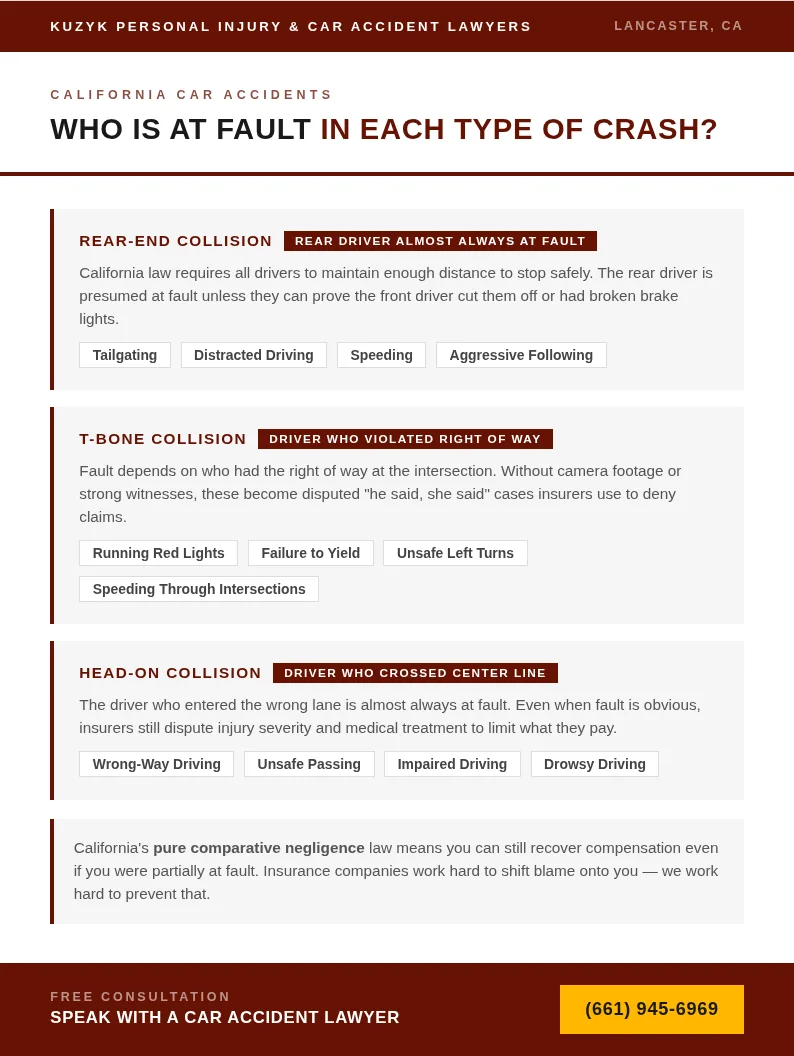 Understanding what caused your crash is crucial for determining who pays for your injuries and damages. California follows pure comparative negligence, which means you can still recover money even if you were partially at fault, but your compensation gets reduced by your percentage of blame.
Insurance companies work hard to shift as much fault onto you as possible because every percentage point of blame reduces what they have to pay. This is why having strong evidence of the cause of the crash is so important.
Who Is at Fault in a Rear-End Crash?
The rear driver is presumed at fault in almost every rear-end collision. California law requires all drivers to maintain enough distance to stop safely.
Common causes that make the rear driver responsible include:
- Tailgating: Following closer than the three-second rule allows
- Distracted driving: Texting, eating, or adjusting the radio instead of watching traffic
- Speeding: Going too fast to stop when traffic slows down
- Aggressive driving: Trying to intimidate other drivers by following closely
There are rare exceptions where the front driver might share fault, like cutting someone off or having broken brake lights. However, insurance companies often unfairly blame front drivers, claiming they stopped for no reason or braked too hard.
Who Is at Fault in a T-Bone Crash?
The fault in T-bone crashes depends on who had the right of way at the intersection. The driver who violates traffic laws is typically responsible for the collision.
The most common fault scenarios include:
- Running red lights: Entering an intersection after the signal turned red
- Stop sign violations: Rolling through stops or failing to yield after stopping
- Unsafe left turns: Turning left in front of oncoming traffic that was too close
- Speeding through intersections: Going too fast to stop when the light changes
Without clear evidence like traffic camera footage or reliable witnesses, these cases can become difficult “he said, she said” disputes. Insurance companies use this uncertainty to deny claims or offer low settlements.
Who Is at Fault in a Head-On Crash?
The driver who crosses the center line into oncoming traffic is almost always at fault in head-on collisions. These crashes don’t just happen by accident. They’re usually caused by serious negligence or illegal behavior.
Common causes include:
- Wrong-way driving: Entering highway ramps or one-way streets in the wrong direction
- Unsafe passing: Crossing double yellow lines to pass other vehicles
- Impaired driving: Driving under the influence of alcohol, drugs, or prescription medications
- Drowsy driving: Falling asleep and drifting across the center line
Even when the fault seems obvious in head-on crashes, insurance companies still try to minimize their payouts by questioning the severity of your injuries or disputing your medical treatment.
What Injuries Are Common in These Collisions?
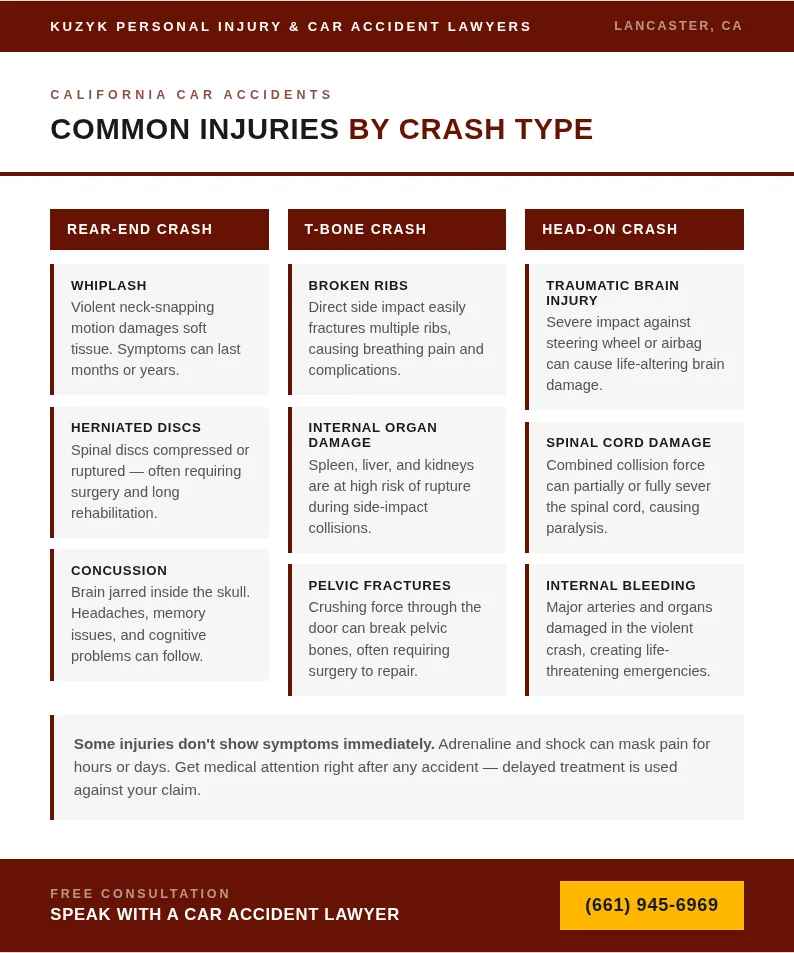
The type of crash often determines what kinds of injuries you’ll suffer. California law allows you to recover compensation for all medical treatment related to your accident injuries, including future care you’ll need.
Some serious injuries don’t show symptoms immediately after a crash. Adrenaline and shock can mask pain for hours or even days, which is why getting medical attention right away is so important.
Neck and Back Injuries After a Rear-End Crash
Rear-end collisions cause a violent whipping motion that injures the soft tissues in your neck and upper back. This is called whiplash, and it’s much more serious than insurance companies want you to believe.
Whiplash symptoms can include:
- Immediate pain: Neck stiffness, headaches, and shoulder pain right after the crash
- Delayed symptoms: Dizziness, memory problems, and sleep difficulties that appear later
- Chronic issues: Long-term pain and reduced range of motion that can last for years
Insurance adjusters love to dismiss whiplash as a “minor” injury to justify lowball settlement offers. The truth is that whiplash can affect your ability to work and enjoy life for months or years after the accident.
Severe rear-end crashes can also cause herniated discs, fractured vertebrae, and other serious spinal injuries that require surgery and extensive rehabilitation.
Chest and Side Injuries After a T-Bone Crash
T-bone crashes are particularly dangerous because your side door and window provide minimal protection from the impact. Your body absorbs most of the force from the other vehicle.
Common side-impact injuries include:
- Broken ribs: Direct impact can easily fracture multiple ribs
- Internal organ damage: Your spleen, liver, and kidneys are vulnerable to rupture
- Pelvic fractures: The crushing force can break pelvic bones, requiring surgery
- Head injuries: Your head can strike the window or door frame, causing concussions or traumatic brain injuries
Children sitting in back seats are especially vulnerable in T-bone crashes because they’re often on the side that gets hit. These injuries often require immediate surgery and long recovery periods.
Brain and Spinal Injuries After a Head-On Crash
Head-on collisions create massive forces that often result in catastrophic injuries. These are life-changing injuries that affect not just you, but your entire family’s future.
The most serious injuries include:
- Traumatic brain injury: Your brain can be severely damaged when your head hits the steering wheel, dashboard, or airbag
- Spinal cord damage: The violent impact can partially or completely sever your spinal cord, causing paralysis
- Multiple fractures: Your legs often get trapped and crushed under the dashboard
- Internal bleeding: Major arteries and organs can be damaged, creating life-threatening emergencies
These injuries typically require multiple surgeries, months of rehabilitation, and lifetime medical care. The costs can easily reach hundreds of thousands of dollars, or even millions.
What to Do After a Rear-End, T-Bone, or Head-On Crash
After any serious crash, you’re probably in pain, confused, and worried about what happens next. Following these steps protects both your health and your legal rights to compensation.
These actions create the evidence you’ll need to prove your case and get fair payment for your injuries and other losses.
Step 1: Call 911 and Get Medical Care
Your health comes first, even if you think your injuries are minor. Call 911 immediately and accept ambulance transport to the hospital if paramedics recommend it.
Adrenaline from the crash can hide serious injuries like internal bleeding, concussions, or spinal damage. Getting checked out at the emergency room creates an official medical record that links your injuries to the accident.
Keep every piece of paper from your medical treatment, including ambulance bills, emergency room records, and follow-up appointments. These documents prove the extent of your injuries and the cost of your care.
Step 2: Gather Photos and Witnesses
Critical evidence disappears quickly after a crash. If you’re physically able, document everything you can see before police clear the scene.
Take photos of:
- Vehicle damage: All cars involved, from multiple angles
- Road evidence: Skid marks, debris, and the final position of vehicles
- Scene conditions: Traffic signals, road signs, weather conditions, and lighting
- Your injuries: Visible cuts, bruises, or other injuries you can see
Get the names and phone numbers of anyone who saw the crash happen. Witnesses often leave before police arrive, and their statements can be crucial for proving fault later.
Step 3: Do Not Give a Recorded Statement
The other driver’s insurance company will probably call you within hours of the crash. They’ll sound friendly and helpful, but their goal is to get you to say something that hurts your case.
When they ask for a recorded statement, simply say: “I need to speak with my attorney before giving any statements.” You have no legal obligation to talk to the other driver’s insurance company.
You do need to report the accident to your own insurance company, but you can limit what you say to basic facts like when and where the crash happened. Avoid speculating about what caused the accident or admitting any fault.
Step 4: Call Kuzyk Law Personal Injury & Car Accident Lawyer
We take over the legal fight so you can focus on getting better. Our first priority is preserving evidence that insurance companies often try to destroy or hide.
We immediately send legal notices to preserve traffic camera footage, vehicle black box data, and the other driver’s phone records. This evidence often disappears within days if we don’t act quickly.
Our offices in Lancaster, Bakersfield, and Fresno give us deep knowledge of California accident law and local court systems. We know which intersections are dangerous, which hospitals provide the best care, and how local juries typically respond to different types of cases.
Injured in a Rear-End, T-Bone, or Head-On Crash?
Right now, you’re probably dealing with medical bills, a damaged car, and insurance adjusters who seem more interested in saving money than helping you. At Kuzyk Law Personal Injury & Car Accident Lawyer, we help people navigate these situations.
We know how overwhelming it feels to handle insurance companies while you’re trying to heal from your injuries. That’s why we take complete control of the legal process from day one.
Here’s what we do immediately:
- Preserve crucial evidence: We secure intersection camera video, black box data, and witness statements before they disappear
- Handle insurance companies: We deal with all adjuster phone calls and fight back against lowball settlement offers
- Arrange medical care: We can connect you with doctors who will treat you now and wait for payment until your case resolves
- Build your case: We hire accident reconstruction experts and medical specialists to prove fault and document your injuries
Whether your crash occurred on the busy streets of Lancaster, at a dangerous Bakersfield intersection, or on Highway 99 near Fresno, we have the local knowledge to build the strongest possible case. Our experience securing client recoveries reflects our commitment and skill.
| Handling It Alone | With Kuzyk Law Personal Injury & Car Accident Lawyer |
| You negotiate against trained insurance adjusters by yourself | We use our extensive experience to fight for maximum compensation |
| You might have to pay medical bills upfront while waiting for settlement | We help arrange medical treatment with no upfront costs |
| You guess what your case might be worth | We calculate all your losses, including future medical care and lost income |
| You face strict legal deadlines and complicated paperwork alone | We handle all court filings and protect your rights throughout the process |
Don’t let insurance companies take advantage of your situation. Call (661) 945-6969 for your free consultation, or fill out our contact form to have us review your case today.
Frequently Asked Questions
Who Is Usually at Fault in a T-Bone Crash?
The driver who violates traffic laws is usually at fault in a T-bone crash. This could be someone who ran a red light, failed to yield the right of way, or made an unsafe left turn in front of oncoming traffic.
What Is the Average Settlement for a Rear-End Crash in California?
There is no “average” settlement because every case is different based on your specific injuries and losses. Minor whiplash cases might settle for a few thousand dollars, while serious spinal injuries could result in settlements worth hundreds of thousands or more.
How Survivable Is a Head-On Collision?
Modern safety features like airbags and crumple zones have made head-on collisions much more survivable than in the past. However, survivors often face catastrophic injuries that require extensive medical treatment and long-term care.
Do I Need a Lawyer if Fault Is Clear?
Yes, because even when the fault seems obvious, insurance companies will still try to minimize what they pay you. They’ll question your injuries, dispute your medical treatment, and offer settlements that don’t cover your full losses.
How Long Do I Have to File a Claim in California?
You have 2 years from the date of the accident to file a personal injury lawsuit in California. However, if your claim involves a government entity like a city or county, you only have six months to file a formal claim.