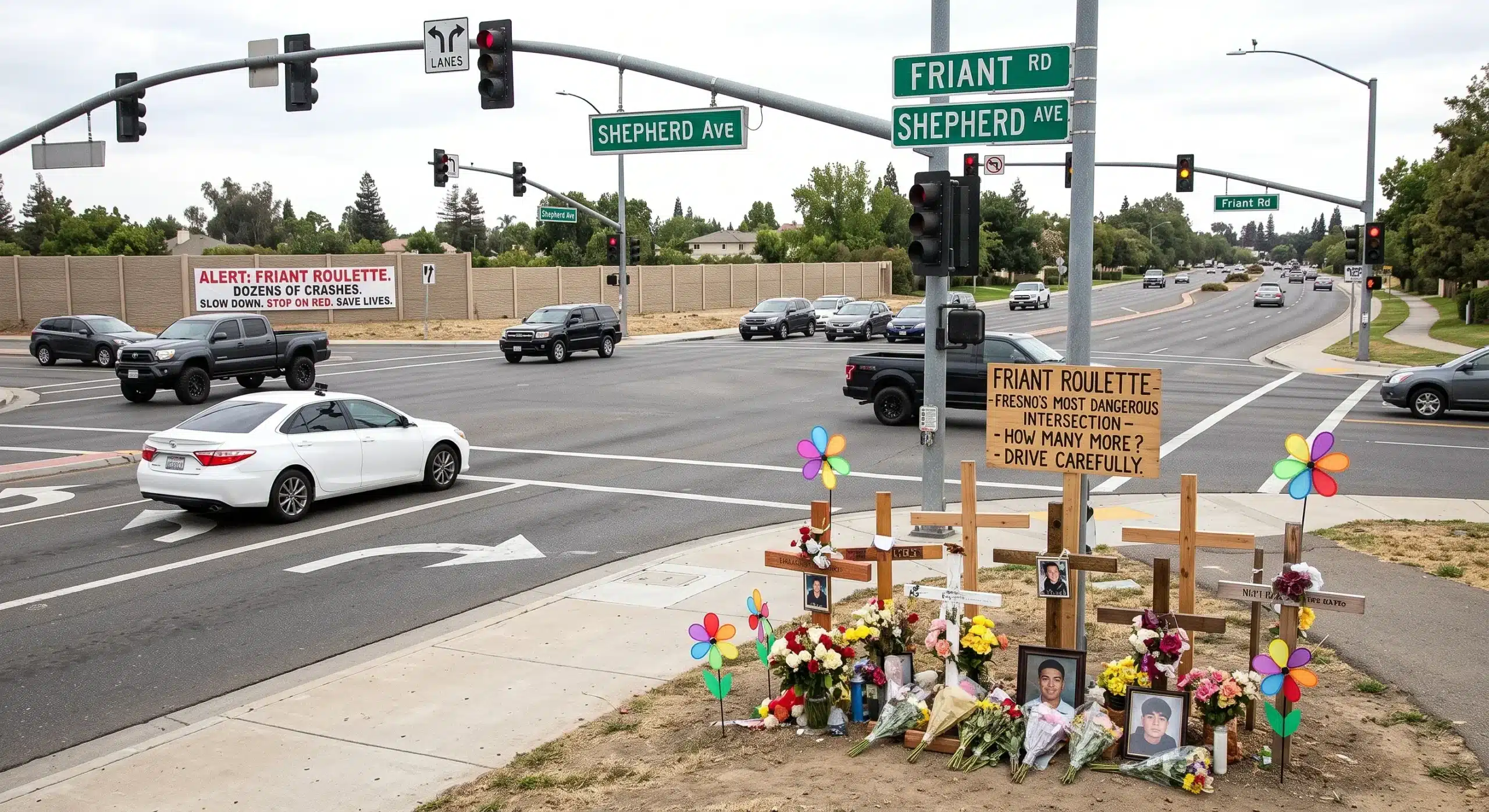
“Friant Roulette” is the nickname Fresno drivers use for Friant Road near Copper Avenue, one of the Central Valley’s most dangerous intersections. High-speed through traffic, limited sightlines, and unprotected left turns combine on a road built for far fewer cars than it now carries. Every trip through this corridor carries real risk.
If you drive Friant Road near Fort Washington Road or Champlain Drive, you already feel it every time you approach the intersection. High speeds collide with residential turn traffic, poor sightlines hide oncoming cars until the last second, and signal timing leaves almost no margin for error. One second of hesitation, or one second of someone else’s, is often all it takes.
This is not one design flaw. There are several problems stacked on the same short stretch of road, at the same time drivers are already accelerating out of Fresno or slowing down from Millerton Lake. Speed differential, missing protected left-turn signals, and thousands of new daily trips from fast-growing subdivisions all collide here, which is exactly why locals warn each other before they warn anyone else.
In this article, you will discover what makes Friant Road so hazardous, the crash types you are most likely to encounter there, and how an auto accident attorney in Fresno, CA, can help if this intersection has left you injured.
Where Is Fresno’s Most Dangerous Intersection?
Friant Road runs northeast from Fresno toward Millerton Lake, passing through a stretch where a rural highway now serves fast-growing suburban neighborhoods. The most dangerous section runs from Copper Avenue through Fort Washington Road and Champlain Drive.
Woodward Park and the San Joaquin River bluffs sit nearby, drawing weekday commuters and weekend recreational drivers, meaning this road rarely quiets down.
Approaches from North and South
Driving south from Millerton Lake, you descend a slope with limited visibility of cross-traffic below. Heading north out of Fresno, you are accelerating to highway speeds at the same moment other drivers are slowing to turn into neighborhoods. Either direction puts you at a disadvantage before you ever reach the intersection.
Safer Alternate Routes
During peak hours, consider these options before entering the corridor:
- Highway 41: Handles north-south travel through Fresno with better-coordinated signals.
- Shepherd Avenue: Runs parallel to Friant Road and is typically less congested during commute hours.
- Willow Avenue: Bypasses the most hazardous section of Friant Road entirely.
Why Is This Fresno Intersection Dangerous?
No single flaw makes Friant Road deadly. It is the combination of speed, outdated design, and traffic volume that makes every approach a calculated risk.
- Speed differential: Although the posted limit is 55 mph, cars decelerating to make a turn travel at a fraction of that.
- Limited sightlines: Curves and elevation changes hide oncoming cars until it is too late to react or brake.
- Outdated infrastructure: New subdivisions have added thousands of daily trips to a road built for far fewer, without expanded lanes or updated signals to match.
Design Factors on Friant Road
Many intersections on Friant Road lack a “protected left-turn phase,” the dedicated green arrow that gives you the exclusive right of way to turn without judging oncoming traffic yourself. Without one, you are making a split-second call against cars traveling at highway speed.
Turn pockets are often too short, pushing waiting vehicles into live traffic lanes, and narrow shoulders leave no room to recover from a mistake.
We consistently see the same mechanism play out at Friant Road’s unprotected turns: a driver waits in a pocket too short to hold them, edges into the through lane to make room for cars behind, and gets struck by traffic that never expected a vehicle there. The narrow shoulders near Fort Washington Road and Champlain Drive give drivers nowhere to recover once that happens.
Driver Behavior Patterns
When road design creates pressure, behavior predictably degrades. Speeding, tailgating, and rolling stops at red lights are consistent patterns on this corridor.
One second of distraction, whether a glance at a phone or a hand reaching for the radio, at 55 mph can eliminate your ability to respond when traffic ahead brakes suddenly for a turn.
High-Risk Times and Weather
- Weekday afternoon commute: Between 3 p.m. and 6 p.m., traffic on Friant Road tends to increase, so drivers should exercise extra caution.
- Weekend lake traffic: Millerton Lake draws recreational drivers unfamiliar with the road’s specific hazards.
- Tule fog: Dense ground fog, a recurring Central Valley weather event, can drop visibility to near zero with almost no warning.
- Low sun angle: Morning and evening glare along this corridor can blind drivers at exactly the moment a decision must be made.
Common Crash Types
The accidents that happen most frequently on Friant Road follow recognizable patterns:
- T-bone (broadside) collisions: One driver fails to yield on a left turn and strikes the side of another vehicle at full speed, often the most catastrophic outcome.
- Rear-end accidents: A closely following car cannot stop in time when the vehicle ahead brakes suddenly for a turn.
- Head-on collisions: A driver misjudges the speed or distance of oncoming traffic and turns directly into an impact.
- Pedestrian and bicycle accidents: Missing crosswalks and no protected shoulder leave walkers and cyclists in the path of highway-speed vehicles.
In our experience, the T-bone and rear-end crashes on this stretch tend to produce more serious injuries than a similar collision on a lower-speed city street, simply because of how much speed is still carried into the point of impact. We routinely see clients arrive at Community Regional Medical Center’s trauma center in Fresno with injuries that trace directly back to that speed differential.
How Do You Drive Friant Road Safely?
You cannot control other drivers. What you can control is your following distance, your approach speed, and the decisions you make before the situation becomes an emergency.
Control Speed and Lane Choice
Avoid lingering in the blind spots of large trucks. Commercial vehicles are common on this stretch and may mask what is developing ahead of you.
Make a Safe Left Turn
An unprotected left turn, one without a dedicated green arrow, is one of the most dangerous moves you can make at any intersection.
Handle Yellow Lights
A yellow light means stop if it is safe to do so, not speed up to clear the intersection.
Night and Rain Safety
In dense tule fog, pulling off the road and waiting is often the safest choice. Driving slowly through near-zero visibility on a 55 mph roadway creates danger for everyone around you.
What Should You Do after a Crash on Friant Road?
The moments after a crash are disorienting. What you do, or do not do, in the first hour directly shapes your health outcomes and your ability to recover compensation.
Call 911 and Document the Scene
Call 911 for any crash, even one that initially seems minor. A police report creates an objective, timestamped record of the event, the parties involved, and what officers observed. Without one, a dispute over fault becomes your word against the other driver’s.
Collect Evidence at the Scene
If you are physically able to move safely, document everything before the scene changes:
- Positions of the vehicles before anything is moved
- Damage to every car involved
- Skid marks, debris, and road conditions
- The other driver’s license, insurance card, and plate number
- Names and contact information of any witnesses
See a Doctor within 24 Hours
Seeing a doctor immediately creates a dated medical record that connects your injuries to the crash, a piece of evidence that becomes essential in any claim.
Notify Insurers Carefully
Report the crash to your own insurance company. Do not give a recorded statement to the at-fault driver’s insurer before speaking with an attorney. Their adjusters are trained to ask questions that reduce or eliminate what you are owed.
Who Pays after a Fresno Car Accident?
But the coverage actually available determines how much you can recover, and from whom.
| Coverage Type | Who It Pays | When It Applies |
| Liability (at-fault driver) | You | The other driver caused the crash |
| Uninsured Motorist (UM) | You | The at-fault driver has no insurance |
| Underinsured Motorist (UIM) | You | The at-fault driver’s limits are too low |
| MedPay | You | Covers medical bills regardless of fault |
Fault and Comparative Negligence
California uses pure comparative negligence. This means you can recover damages even if you shared some responsibility for the crash. If you were 25% at fault, you still collect 75% of your award. The at-fault driver’s insurer will work to raise your fault percentage, because every point they add reduces what they owe you.
Uninsured and Underinsured Coverage
Carry UM/UIM coverage. It is the protection you control.
Claims against Government Entities
If poor road design, such as an absent turn arrow, inadequate shoulder, or misleading lane markings, contributed to your crash, you may have a valid claim against the City of Fresno, Fresno County, or Caltrans. The deadline to file that government tort claim is six months from the date of your injury.
That is far shorter than the standard two-year personal injury deadline. Miss it, and you permanently lose the right to pursue that entity.
We have seen the six-month government tort claim deadline catch injured drivers off guard more than almost any other rule in these cases, especially when the City of Fresno, Fresno County, or Caltrans shares responsibility for a missing turn arrow or a known design defect on Friant Road. Waiting even a few weeks past the crash to sort out fault can be the difference between a viable claim and no claim at all.
Injured near Friant Road? Get Legal Help Today
Our firm represents injury victims. Five decades. More than 100,000 clients. Over $1.25 billion recovered.
That singular focus tells you whose side we are on, and it tells the insurer across the table exactly what they are dealing with.
We prepare every case for trial from the first call. That posture changes the outcome. We’ve helped clients obtain much larger settlements than the insurer’s initial offers. We have resolved cases totaling $2.8 million that began at a fraction of that amount. We know what a Fresno intersection crash is worth, and we are not in the business of closing cases cheap.
We work on contingency. You pay nothing unless we win.
Because winning matters.
But what you keep matters more.
Call us 24/7. Someone is always here.
Frequently Asked Questions
What Is the Most Dangerous Intersection in Fresno, California?
The stretch of Friant Road near Copper Avenue is consistently flagged by local drivers and traffic data alike as one of Fresno’s most dangerous intersections, which is how it earned the nickname “Friant Roulette.”
What Is the Most Common Cause of Left-Turn Crashes at Unprotected Intersections?
Drivers most often misjudge the speed or distance of oncoming traffic, which causes them to turn directly into the path of a vehicle traveling at highway speed.
When Is Crash Risk Highest on Friant Road?
Risk peaks during the weekday afternoon commute between 3 p.m. and 6 p.m. and on weekends when recreational drivers travel to and from Millerton Lake.
How Long Do I Have to File a Car Accident Claim in California?
You generally have two years from the date of your injury to file a personal injury lawsuit, but if a government entity shares fault, you must file a formal tort claim within six months.
What If Caltrans or the City of Fresno Shares Fault for My Accident?
You must file a government tort claim within six months of the crash. Miss that window and you permanently forfeit the right to pursue that entity, regardless of how strong your case is.
Will My Insurance Rates Go Up If I Use Uninsured Motorist Coverage?
No. California law prohibits insurers from raising your premium for filing a UM/UIM claim when the accident was not your fault.
How Much Does a Fresno Car Accident Lawyer Cost?
Kuzyk Personal Injury & Car Accident Lawyers works on a contingency-fee basis. There are no upfront fees, and we are paid a percentage of what we recover for you, only if we win your case.