
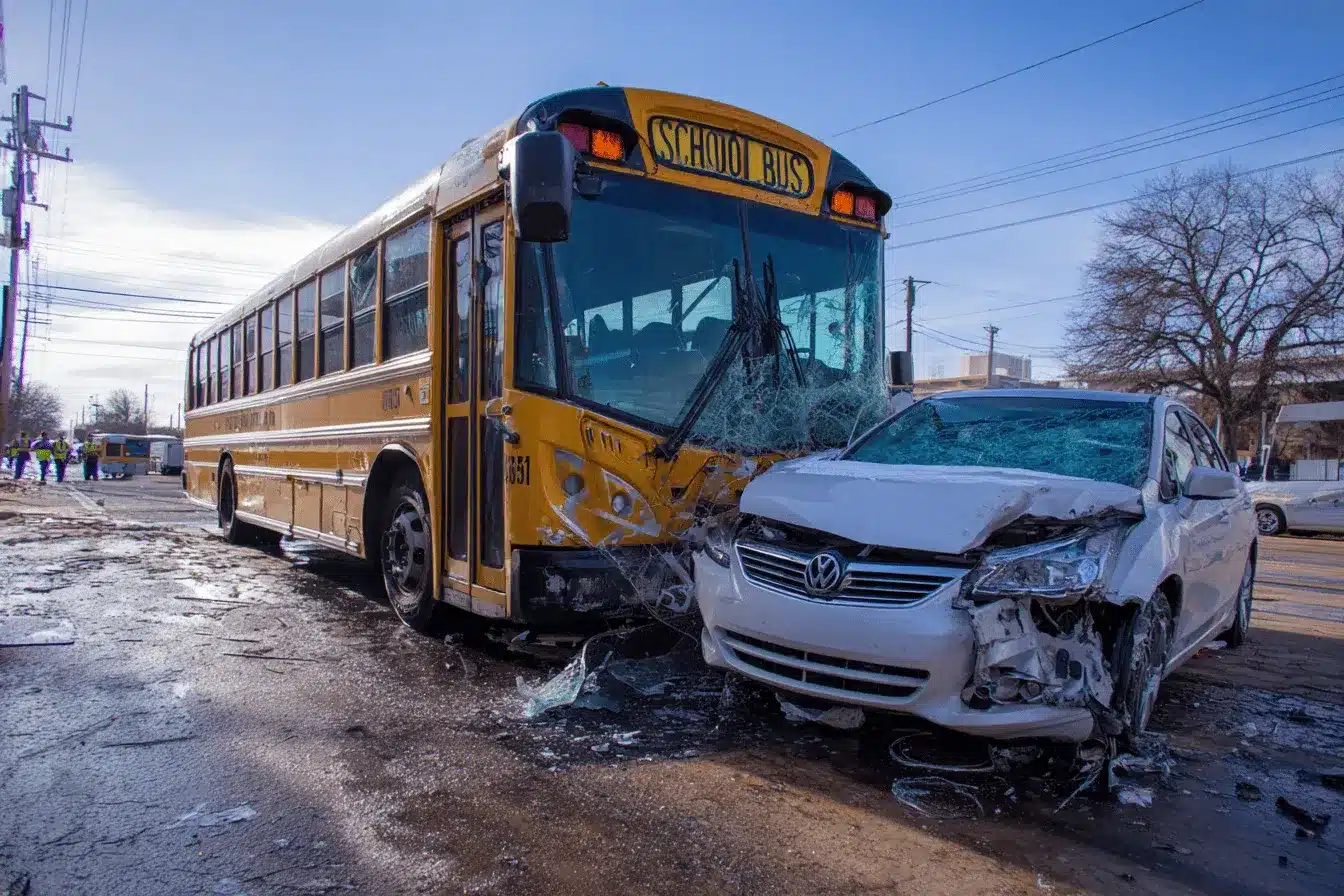
To file a bus accident lawsuit in California, identify the liable parties, gather evidence, and file within the statute of limitations. Claims against government agencies require a government tort claim filed within 6 months of the incident. Missing this deadline eliminates your right to sue, making early legal action critical.
A bus accident in California can cause serious injuries in an instant, and the days that follow are often filled with confusion, medical appointments, and pressure from insurance adjusters. Whether the crash occurred on a Lancaster city bus, a school district vehicle, or a private charter coach, the legal process that follows is more complex than that of a standard car accident claim. Multiple parties may share responsibility, and the rules for filing differ depending on whether a government agency or a private company operated the bus.
The challenge grows because California imposes strict deadlines that vary based on who is being sued. Claims against public transit agencies require a formal government tort claim within just 6 months of the accident. Miss that window, and you lose your right to compensation entirely, regardless of how serious your injuries are. Private bus company claims carry their own filing requirements, and determining which deadlines apply requires identifying every potentially liable party before time runs out.
In this article, you will discover how to file a bus accident lawsuit in California, what deadlines and legal requirements apply to your specific case, and how a bus accident attorney can help you navigate the process and pursue the full compensation you deserve.
How to File a Bus Accident Lawsuit in California: Step by Step
To file a bus accident lawsuit in California, you need to preserve evidence, file insurance claims, meet government deadlines if a public bus was involved, and file your lawsuit before the legal deadline. The process has more steps than a typical car accident claim, and missing even one can cost you your right to compensation.
Step 1: Preserve Evidence and Bus Video
Bus companies and transit agencies may overwrite onboard camera footage after a retention period. A spoliation letter is a formal written demand that forces the bus company to save that footage, GPS data, and driver logs. We send this letter the same day you hire us so that critical evidence is protected before it disappears.
Step 2: File Insurance Claims With All Liable Parties
You may need to file claims with multiple insurance companies at the same time, including the bus company, other drivers involved, and your own insurer. Your own UM/UIM coverage, which stands for uninsured or underinsured motorist coverage, can step in if the at-fault party does not have enough insurance to cover your losses. Never sign anything labeled a “release” or “final settlement” until you know the full value of your injuries.
Step 3: File a Government Claim if a Public Bus Was Involved
This is the step that catches most people off guard. If the bus was operated by a city, county, school district, or any other government agency, you must file a formal written claim with that agency within six months of the crash. This requirement comes from the California Government Claims Act. The agency has 45 days to respond, and if they deny your claim, you then have six months to file a lawsuit in court.
Public buses that trigger this six-month rule include:
- LA Metro and Big Blue Bus: Operated by city or county transit authorities
- School district buses: Including charter routes run on behalf of a district
- Municipal shuttles: City-run airport, senior, or paratransit services
- Caltrans contractor buses: Vehicles operating under state contracts
Step 4: File the Lawsuit Before the Deadline
For accidents involving private bus companies, California law gives you two years from the date of the crash to file a lawsuit under Code of Civil Procedure 335.1. For government bus cases, you have six months from the date your claim is denied. We handle every filing requirement so you do not lose your case over a missed deadline.
Step 5: Go Through Discovery, Negotiations, and Trial
After a lawsuit is filed, both sides exchange evidence in a process called discovery. This includes depositions, which are recorded, sworn statements from witnesses and parties involved. Most cases settle during negotiations or mediation, which is a structured meeting with a neutral third party. The cases that recover the most money are the ones built for trial from the start, even if they never reach a courtroom.
Related: How to File a Personal Injury Lawsuit in California
Do You Have a Case Under California Bus Laws
California law classifies buses as common carriers, which means any vehicle that transports paying passengers for a fee. Under Civil Code 2100, common carriers must exercise the highest possible level of care, a stricter standard than that applied to regular drivers. If a bus driver or company failed to meet that standard and you were hurt as a result, you likely have a valid case.
Who Can Be Held Liable After a Bus Accident
Bus crashes often involve more than one responsible party, which can work in your favor when it comes to recovering full compensation. We investigate every possible source of liability so nothing is left on the table.
Bus Driver and Company
The bus company is legally responsible for the actions of its driver while on the job. This is called vicarious liability. The company can also face direct liability if it hired an unqualified driver, skipped required training, or pushed drivers to work beyond legal hour limits.
City or County Transit Agency
If your accident involved a city or county bus, the transit agency that operates it can be held liable. Any claim against a public transit agency is subject to the six-month government claim deadline described above.
School District
School districts can be liable for accidents caused by unqualified drivers, unsafe drop-off or loading zones, or a failure to supervise students. The six-month government claim deadline applies to school district cases as well.
Maintenance Shops and Manufacturers
If the crash was caused by a mechanical failure, such as a brake failure, tire blowout, or steering defect, the repair shop or the bus manufacturer may share responsibility. This falls under product liability law, and preserving the physical evidence of the defect is critical.
Other Drivers
If another motorist caused the bus to crash, that driver can also be held liable. This is especially common in chain-reaction accidents on busy California highways.
What Should You Do First After a Bus Crash
The actions you take in the first 48 hours after a bus crash have a direct impact on the strength of your case.
Get Medical Care and Report the Crash
See a doctor the same day, even if you feel fine. Adrenaline masks pain, and delayed symptoms are common in crashes. Any gap in medical treatment gives insurance adjusters a reason to argue your injuries were not caused by the accident.
Document the Scene
If you are physically able, use your phone to capture as much evidence as possible before leaving the scene.
- Bus identification: Route number, bus number, and license plate
- Driver information: Name and badge number if visible
- Damage: Photos of all vehicles involved and the surrounding area
- Your injuries: Visible cuts, bruises, or swelling
- Witnesses: Names and phone numbers of at least two bystanders or fellow passengers
- Camera locations: Note any nearby security cameras on storefronts or traffic signals
Avoid Recorded Statements and Call a Lawyer
Insurance adjusters often call within 24 hours of the crash. Their goal is to get you to say something that reduces your claim. You can simply tell them, “I am not giving a recorded statement until I speak with my attorney.” We handle all adjuster communication so you are not put in that position.
What Deadlines Apply to California Bus Accident Lawsuits
You generally have two years to file a private bus accident lawsuit and only six months to file a claim against a public bus operator. The table below shows how deadlines break down by responsibility.
| Type of Bus Defendant | Deadline | Legal Basis |
| Private bus company or charter | 2 years from crash | CCP 335.1 |
| Public transit, school, or city bus | 6 months for claim | Gov. Code 911.2 |
| Wrongful death | 2 years from death | CCP 335.1 |
| Minor child injured | Until age 20 (private) | CCP 352 |
Missing any of these deadlines typically ends your right to file, with very few exceptions. Acting quickly is not just helpful; it is necessary.
How Do You Prove a Bus Accident Case
Strong cases are built on documented evidence, not your word against the bus company’s. We start gathering proof immediately so that nothing is lost.
- Police reports and 911 audio: We obtain the Traffic Collision Report and any recorded 911 calls to establish a clear timeline of the crash.
- Bus camera footage and GPS data: Telematics is the term for the automatic GPS and speed data buses record. Combined with onboard video, this data shows exactly what the driver was doing before impact.
- Maintenance and inspection logs: These records reveal whether the company skipped required safety checks, which directly supports a negligence claim.
- Medical records: Your treatment records connect each injury to the crash and document the full cost of your care.
- Lost wage documentation: Pay stubs, tax returns, and employer letters establish both past and future income losses.
What Compensation Can You Recover in a Bus Accident Lawsuit
Bus accident victims in California can recover both economic and non-economic damages. Economic damages are losses with a specific dollar amount attached, like medical bills and lost wages. Non-economic damages cover the personal impact of the injury, like physical pain, emotional distress, and the loss of activities you used to enjoy.
In rare cases where a bus company or driver acted with extreme recklessness, such as a driver operating under the influence, a court may also award punitive damages. These are meant to punish the wrongdoer, not just compensate you.
We work with medical providers who treat clients on a lien, which means you receive care without paying upfront. The bills are settled from your final compensation.
Related: Average Bus Accident & Injury Compensation in Bakersfield, CA
What If You Were Partly at Fault for the Bus Crash
California follows a rule called pure comparative negligence. This means you can still recover compensation even if you were partly at fault, but your total award is reduced by your percentage of fault. If a jury awards you $100,000 and finds you were 20 percent at fault, you receive $80,000. Partial fault does not end your case.
Why Hire Kuzyk Law Personal Injury & Car Accidents Lawyers
When you are up against a large transit company or a government agency with its own legal team, having experienced representation makes a real difference.
- 100,000+ clients represented since 1971: You get a team experienced in handling bus crash cases under California law.
- $1.25 billion+ recovered: We evaluate each case’s value and vigorously push back against low settlement offers from transit insurers.
- Trial-ready preparation: Our willingness to take cases to a jury gives us real leverage in negotiations.
- Local offices in Lancaster, Bakersfield, and Fresno: You work with attorneys who know the local courts and transit agencies.
- No fees unless we win: We work on a contingency fee basis, so there is no financial risk to you.
Many of our clients come to us through referrals, reflecting the trust we have earned over decades of consistent results. Whether you need a Lancaster bus accident lawyer, a Bakersfield bus accident lawyer, or a Fresno bus accident lawyer, we handle the legal process so you can focus on getting better.
Frequently Asked Questions
Do Public Bus Accident Claims in California Require a Government Claim First?
Yes. Any accident involving a publicly operated bus, including LA Metro, school district buses, and municipal shuttles, requires you to file a government claim within six months of the crash before you can file a lawsuit.
How Long Does a Bus Accident Lawsuit Usually Take to Resolve?
Many bus accident cases in California resolve through settlement, though those that proceed to trial often take longer to conclude.
Can a Pedestrian or Cyclist Hit by a Bus File the Same Type of Claim?
Yes. Pedestrians and cyclists injured by buses file claims through the same process and are often in a strong position to prove liability.
Should You Accept the Insurance Company’s First Settlement Offer?
No. First offers are almost always far below the actual value of your case and may close your claim before the full extent of your injuries is known.
Can You Still Sue if the Bus Driver Was Not Cited by Police?
Yes. A police citation is not required to file a civil claim. We establish liability based on evidence gathered during our own investigation, independent of the police report.